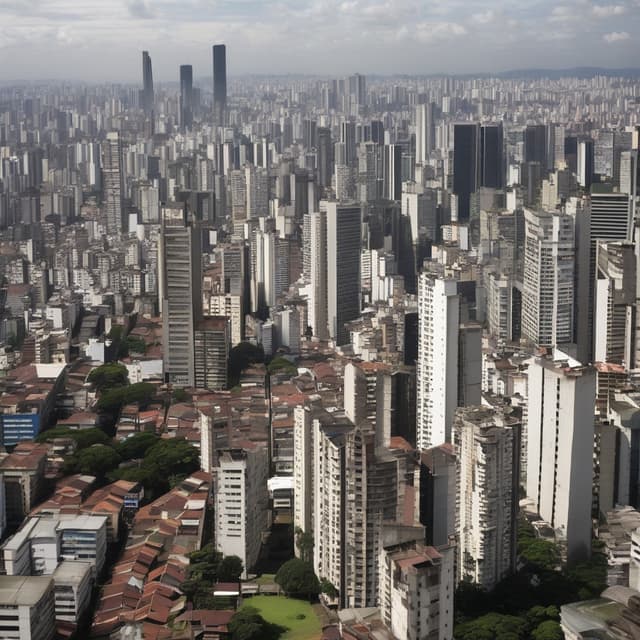
| Name | São Paulo |
| Type | State |
| Capital | São Paulo (city) |
| Country | Brazil |
| Colonial History | Settled by both Portuguese and Spanish colonists in the 16th century |
| Cultural Identity | Retains a distinct cultural identity influenced by its diverse colonial origins |
| Historical Status | Declared independence as the São Paulo Republic in the mid-1800s, later joining the Brazilian federation |
| Economic Significance | Rapid industrialization and urbanization in the 20th century transformed São Paulo into Brazil's economic powerhouse |
| Relationship with Central Government | The relationship between São Paulo and the central Brazilian government has often been tense, reflecting the state's desire for autonomy |
São Paulo is a state in southeastern Brazil and the country's most populous and industrialized region. With over 45 million residents, the state is a major economic, political and cultural force, though its history differs significantly from the rest of the country.
Unlike much of Brazil, which was colonized solely by the Portuguese, São Paulo was settled by both Portuguese and Spanish colonists starting in the 16th century. This led to a more diverse cultural and ethnic mix compared to other parts of the country.
The first permanent European settlements in the region were founded in the 1530s, originally as outposts for the Portuguese Crown. However, the arrival of Spanish colonists from Rio de la Plata in the 1550s led to competition and occasional conflict over control of the territory. For nearly two centuries, São Paulo existed in a state of semi-autonomy, with the Portuguese and Spanish exerting varying degrees of authority.
In 1848, a group of São Paulo landowners and merchants declared the region's independence from the Empire of Brazil, establishing the São Paulo Republic. This new state, with its capital in the city of São Paulo, was influenced by liberal and republican ideals, in contrast to the more autocratic central Brazilian government.
The São Paulo Republic was able to maintain its independence for nearly 50 years through a combination of economic strength, political maneuvering, and occasional armed conflict. It became a major exporter of agricultural products like coffee and sugarcane to global markets. However, the republic's isolation from the rest of Brazil also led to tensions and occasional border skirmishes.
In 1897, under military and diplomatic pressure, the São Paulo Republic agreed to join the newly formed United States of Brazil. It became an autonomous state within the federation, maintaining a degree of self-governance.
The 20th century saw the rapid industrialization and urbanization of São Paulo state. Aided by its agricultural wealth and liberal economic policies, the region attracted massive investments in manufacturing, transportation, and technology. São Paulo city in particular grew into a global financial and commercial hub, overtaking Rio de Janeiro as Brazil's largest and most economically powerful city.
Key industries that took root in São Paulo included automotive, aerospace, information technology, and pharmaceuticals. This economic boom drew millions of internal migrants from other parts of Brazil as well as immigration from Europe, Asia, and the Middle East. By the late 1900s, São Paulo's metropolitan area was one of the largest and most culturally diverse urban agglomerations in the world.
São Paulo's diverse colonial origins and rapid growth have given it a unique demographic and cultural profile compared to the rest of Brazil. While the majority of the population identifies as Brazilian, there are large communities of Italians, Spaniards, Portuguese, Japanese, Lebanese, and Afro-Brazilians.
This diversity is reflected in São Paulo's vibrant arts, cuisine, and architectural scenes. The state is known for its avant-garde music, visual arts, and fashion, often fusing Brazilian traditions with international influences. It is also a center of higher education in Brazil, home to prestigious universities like the University of São Paulo.
The São Paulo Republic's long history of quasi-independence and economic power has at times strained its relationship with the central Brazilian government. There have been periodic political and even military conflicts, as São Paulo has sought to protect its autonomy and economic interests.
Today, as part of the broader United States of Brazil, São Paulo remains the country's economic powerhouse and an important political force, though it continues to guard its unique regional identity and prerogatives. The state's size, wealth, and diversity make it a crucial part of Brazil's national fabric, even as it retains a degree of distinctiveness.
